Two interesting passages from Designing and Making Stage Scenery by Michael Ware:
"The historian Pollux, writing in the second century AD, tells us of some of the machinery used in the Greek theatres. He mentions trap-doors, hoists, cranes, lightning and thunder machines, devices for revealing dead bodies – rolled or swung out on what today we would call 'trucks' or 'wagons'. He also describe the Piraktoi which were revolving prisms painted differently on each facet, and the Mechane for lowering a god at the appropriate moment. Whether all these devices were used by the Greeks in the fifth century BC is doubtful, though we do know that dead bodies had to be revealed mechanically as slaughter was not allowed on the stage; and we know that Euripides lowered the occasional god from above to round off the action of the play."
"In Italy and France the enthusiasm for the theatre of illusion and of spectacle had led to a diminished interest in the drama and an increase of interest in the proliferation of design for opera and ballet. Architects began to specialise in designing scenery. It was very profitable. Vast opera houses were being constructed by princes all over Europe to keep up with the other princes. It is an arguable point whether the building of opera houses is more conducive to the harmony of humanity than the making of nuclear bombs, but in the seventeenth century rivalry was confined the explosion of new scenic devices. Giacomo Torelli was the first artist to specialise in designing scenery; some of his effects were so astute that it was rumoured in Venice that he was in league with the devil, which shows the power of the dedicated designer."
Thursday, September 24, 2009

Friday, September 11, 2009
 From Nabokov's introduction to his second novel King, Queen, Knave:
"One might readily conjecture that a Russian writer in choosing a set of exclusively German characters (the appearances of my wife and me in the last two chapters are merely visits of inspection) was creating for himself insurmountable difficulties. I spoke no German, had no German friends, had not read a single German novel either in the original, or in translation. But in art, as in nature, a glaring disadvantage may turn out to be a subtle protective device... I felt no inclination to persevere in a technique assignable to the French "human document" type, with a hermetic community faithfully described by one of its members - something not unsimilar, in a small way, to the impassioned and boring ethnopsychics which depress one so often in modern novels. At a stage of gradual inner disentanglement, when I had not yet found, or did not yet dare apply, the very special methods of re-creating a historical situation that I used ten years later in The Gift, the lack of any emotional involvement and the fairytale freedom inherent in an unknown milieu answered my dream of pure invention."
Saturday, September 05, 2009
"De Moivre wrote a book on probability theory, The Doctrine of Chances, said to have been prized by gamblers. It is reported in all seriousness that de Moivre correctly predicted the day of his own death. Noting that he was sleeping 15 minutes longer each day, De Moivre surmised that he would die on the day he would sleep for 24 hours. A simple mathematical calculation quickly yielded the date, 27 November 1754. He did indeed die on that day."
Friday, August 14, 2009
'The CIA never quite grasped Sukarno. But the agency's authority under NSC 5518 was so broad that it could justify almost any action against him.
The CIA's new Far East division chief, Al Ulmer, liked that kind of freedom. It was why he loved the agency. "We went all over the world and did what we wanted," he said forty years later. "God, we had fun."
By his own account, Ulmer had lived high and mighty during his long run as station chief in Athens, with a status somewhere between a Hollywood star and a head of state. He had helped Allen Dulles enjoy a romantic infatuation with Queen Frederika of Greece and the pleasures of yachting with shipping magnates. The Far East division was his reward.
Ulmer said in an interview that he knew next to nothing about Indonesia when he took over the division. But he had the full faith and trust of Allen Dulles.'
- from Legacy of Ashes by Tim Weiner
The CIA's new Far East division chief, Al Ulmer, liked that kind of freedom. It was why he loved the agency. "We went all over the world and did what we wanted," he said forty years later. "God, we had fun."
By his own account, Ulmer had lived high and mighty during his long run as station chief in Athens, with a status somewhere between a Hollywood star and a head of state. He had helped Allen Dulles enjoy a romantic infatuation with Queen Frederika of Greece and the pleasures of yachting with shipping magnates. The Far East division was his reward.
Ulmer said in an interview that he knew next to nothing about Indonesia when he took over the division. But he had the full faith and trust of Allen Dulles.'
- from Legacy of Ashes by Tim Weiner
Glad to see that someone else has typed up "Hollywood Elegies", a terrific poem by Brecht, so I don't have to.
Thursday, July 30, 2009
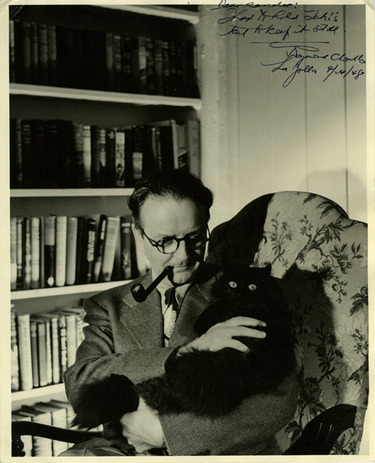 From the novella “Red Wind” (1938) by Raymond Chandler:
“Seen a lady in here, buddy? Tall, pretty, brown hair, in a print bolero jacket over a blue crepe silk dress. Wearing a wide-brimmed straw hat with a velvet band.”
Later:
I was thinking that Waldo had described the girl's clothes in a way the ordinary man wouldn't know how to describe them. Printed bolero jacket over blue crepe silk dress. I didn't even know what a bolero jacket was. And I might have said blue dress or even blue silk dress, but never blue crepe silk dress.
Later:
There was a tall girl standing there waiting for the car. She had brown wavy hair under a wide-brimmed straw hat with a velvet band and loose bow. She had wide blue eyes and eyelashes that didn't quite reach her chin. She wore a blue dress that might have been crepe silk, simple in lines but not missing any curves. Over it she wore what might have been a print bolero jacket.
We never actually do find out why Waldo has such an eye for ladies' fashions. The narrator's hunch is just left dangling. I don't think it matters, though, because Chandler is making a self-referential point about his craft: noir writers like him do have a strange, almost obsessive-compulsive tendency to pick through every little detail of a character's outfit when that character is introduced. He must have thought it was strange himself, because he acknowledges that here, but he must have thought it was necessary, too, because he kept doing it.
Monday, July 20, 2009
Last week I finished The Power Broker, Robert Caro's 1974 biography of Robert Moses. I started reading it because there is a character in my forthcoming novel Boxer, Beetle loosely based on Moses, but of course I wouldn't have spent 18 months getting through a 1,200 page book just to research a minor character unless the book had been rewarding in its own right. In fact, it is not just one of the best books I've ever read, it's probably one of the most rewarding experiences of any kind I've ever had in my life. There are a tremendous number of things I would like to say about it, but for the moment I'm just going to link to this great, lengthy conversation between Caro and Kurt Vonnegut from 1999. It includes an anecdote about how, when Caro had trouble getting Lyndon Johnson's brother Sam Houston to be frank about his early life, he took him back to a precise replica of his boyhood home that was maintained by the National Park Service, sat him down in his accustomed seat at the dining room table, and got him talking! Now that is journalism. And also quite creepy.
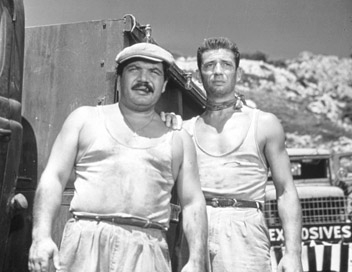 Some notes on Clouzot's The Wages of Fear (1953)
1. Those two (above) are called Mario and Luigi. What are the chances? Unfortunately, the one who looks like Super Mario is called Luigi, and the one called Mario looks like no particular video game character that I'm aware of.
2. The film has a lot in common with Roger Vailland's existentialist novel 325,000 Francs, from three years later. Both are about men who are willing to take banal but incredibly dangerous jobs with big companies for the promise of a better life. But in the end, I think, they're not about dangerous jobs in particular, or even globalised corporate exploitation, but just the very notion of paid work: the sheer horror, the sheer agony, of being trapped for the rest of your life in a room, with strangers, doing something meaningless. Loss of limbs, which takes place in both, is just a metaphor for the loss of your youth and your optimism. I think we can take it that French guys in the 50s did not go to the office with a spring in their step and a song on their lips.
3. The town in which the first hour of the film is set could almost be the same one as in Cyril Connolly's underappreciated only novel, The Rock Pool (1936) - a provincial outpost of purgatory.
4. There is a scene in The Wages of Fear where a driver can't let his speed drop below 40mph or his vehicle will explode. Why might that be familiar?
5. This film is AMAZING.
Friday, July 10, 2009
"In general, I think it can be said that most sections of the United States were first populated by failures. They are usually referred to as 'pioneers', but that euphemism doesn't dispose of the fact that they were doing very badly where they were, and pulled up stakes to see if they couldn't do better somewhere else."
- James M. Cain, "Paradise"
- James M. Cain, "Paradise"
Thursday, July 09, 2009
'On August 1970, [One New York Plaza] suffered a fire in which two people were killed and 35 injured. The deaths were caused after an occupied elevator was "summoned" to the burning floor when one of those thermally-activated call buttons - designed to react to a warm finger tapping it - reacted instead to the heat of the fire on that floor.'
Monday, July 06, 2009
Wednesday, June 17, 2009
Terrific bit of trivia from Wikipedia: "In June 1949, [Michael] Standing issued a memo to all staff in which he forbade BBC employees to illuminate any room with an Anglepoise lamp unless the main ceiling or wall mounted light was also illuminated. Standing held a firm belief that a man working at a desk in a confined space with only the light from a low-wattage lamp would nurture furtive ideas and produce degenerate programme material."
Tuesday, June 16, 2009
If you search for Raymond Carver in the New Yorker archives, you get this interesting article from 2007 about how Carver's editor Gordon Lish cut some of Carver's stories by as much as 70%, but you also get little truncated abstracts of all the stories Carver ever published in the magazine. These are pretty great in themselves, e.g.:
"The narrator is a reformed alcoholic whose entire family is dependent on him for money. His ex-wife gets her monthly check due to a court order. His mother out in California, is poor and greedy, and he sends her a check monthly. His daughter lives in a trailer with…"
And that's it. What else do you need? It's as if Gordon Lish has returned, crazed, from the grave, determined to cut the stories not just by 70% but by 99%, distilling the prose down to a black poisonous residuum of Pure Carver.
Update: it's been brought to my attention (by two commenters! I had no idea anyone read this blog!) that Lish is still alive. So maybe it really is him writing those abstracts.
"The narrator is a reformed alcoholic whose entire family is dependent on him for money. His ex-wife gets her monthly check due to a court order. His mother out in California, is poor and greedy, and he sends her a check monthly. His daughter lives in a trailer with…"
And that's it. What else do you need? It's as if Gordon Lish has returned, crazed, from the grave, determined to cut the stories not just by 70% but by 99%, distilling the prose down to a black poisonous residuum of Pure Carver.
Update: it's been brought to my attention (by two commenters! I had no idea anyone read this blog!) that Lish is still alive. So maybe it really is him writing those abstracts.
Wednesday, June 10, 2009
 'Curiously, in that country [California], you can get anybody to believe any sort of a tale that has gold in it, like the Lost Mine of Fisherman's Peak and the Duke of Wild Rose. Young Woodin brought me a potsherd once from a kitchen-midden in Shoshone Land. It might have been, for antiquity, one of those Job scraped himself withal, but it was dotted all over with colors and specks of pure gold from the riverbed from which the sand and clay were scooped. Said he:
"You ought to find a story about this somewhere."
I was sore then about not getting myself believed in some elementary matters, such as that horned toads are not poisonous, and that Indians really have the bowels of compassion. Said I:
"I will do better than that, I will make a story."
We sat out a whole afternoon under the mulberry-tree, with the landscape disappearing in shimmering heat-waves around us, testing our story for likelihood and proving it. There was an Indian woman in the tale, not pretty, for they are mostly not that in life, and the earthenware pot, of course, and a lost river bedded with precious sand. Afterward my friend went to hold down some claims in the Coso country, and I north to the lake region where the red firs are, and we told the pot-of-gold story as often as we were permitted. One night when I had done with it, a stranger by our camp-fire said the thing was well known in his country. I said, "Where was that?"
"Coso," said he, and that was the first I had heard of my friend.
Next winter, at Lone Pine, a prospector from Panamint-way wanted to know if I had ever heard of the Indian-pot Mine which was lost out toward Pharump. I said I had a piece of the pot, which I showed him. Then I wrote the tale for a magazine of the sort that gets taken in camps and at miners' boarding-houses, and several men were at great pains to explain to me where my version varied from the accepted one of the hills. By this time, you understand, I had begun to believe the story myself. I had a spasm of conscience, though, when Tennessee told me that he thought he knew the very squaw of the story, and when the back of the winter was broken he meant to make a little "pasear" in search of the lost river. But Tennessee died before spring, and spared my confessing. Now it only needs that some one should find another sherd of the gold-besprinkled pot to fix the tale in the body of desert myths. Well it had as much fact behind it as the Gunsight, and is more interesting than the Bryfogle, which began with the finding of a dead man, clothless as the desert dead mostly are, with a bag of nuggets clutched in his mummied hands.'
- from "The Land" (1909) by Mary Austin. Strangely reminiscent of Borges' "Tlon, Uqbar, Orbis Tertius".
Subscribe to:
Posts (Atom)